

Your bank staff are your most underused asset

When the sandbox is overflowing but your rota is thin—remember that help is just on the other side of the fence.
Most nursery groups are sitting on a staffing solution they already own — and managing it with tools that weren't built for Early Years.
Most Early Years providers fall into one of two traps. The first is heavy reliance on staffing agencies — high rates, inconsistent quality, and relationships you don't own. The second is over-hiring permanent staff as a buffer against absence, carrying a wage bill that doesn't reflect actual need. Both are expensive. Both are avoidable. Yet in most nursery groups, the real answer to a last-minute absence is sitting dormant in a WhatsApp group.
Bank staff — your pool of known, vetted, trained practitioners who have already worked in your rooms — represent a staffing asset that the majority of providers systematically underuse. Not because they don't want to use them, but because the tools they're using make it harder than it should be.
Stop draining your budget on agency fees and over-hiring—there is a smarter way to approach staffing
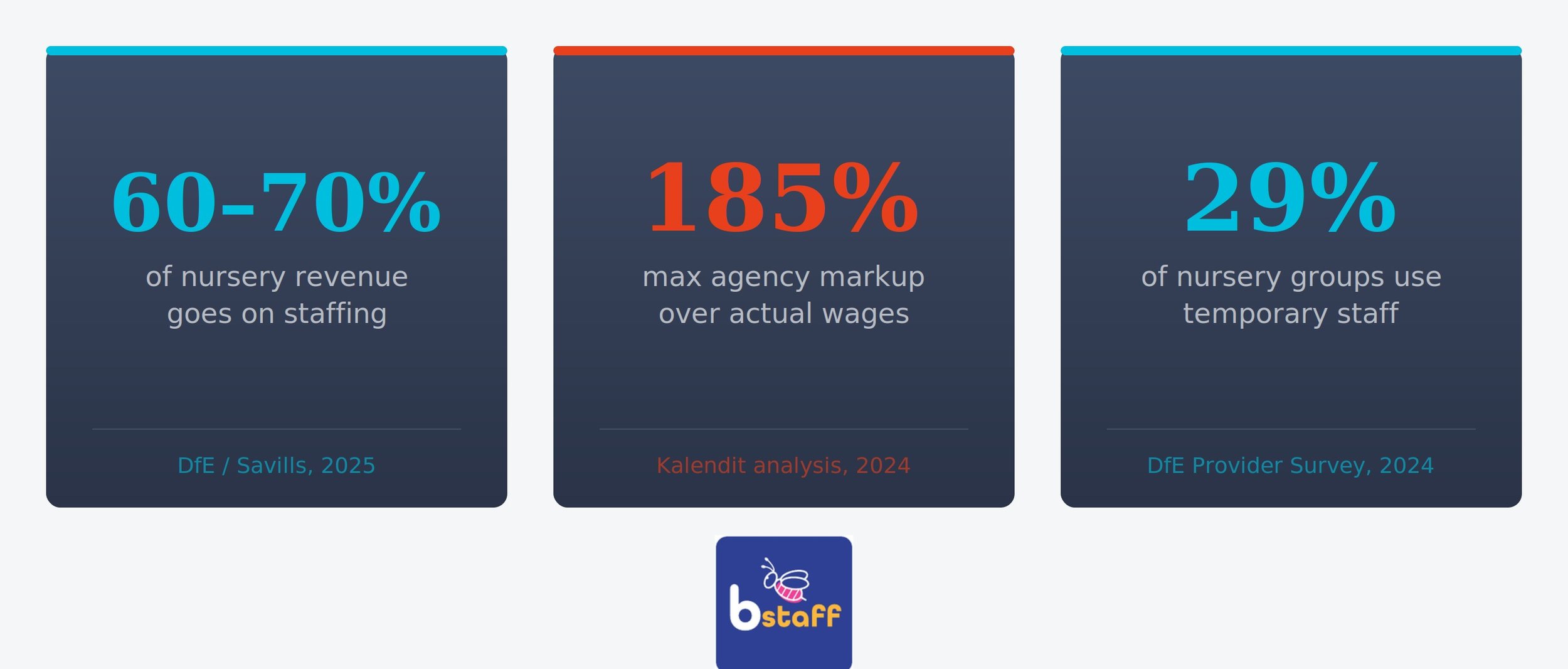
60–70% of nursery revenue goes on staffing — making every hiring decision a financial one
Source: DfE / Savills, 2025185% - maximum markup charged by agencies over a practitioner's actual hourly wage
Source: Kalendit analysis, 202429% of group-based nursery providers employ temporary paid staff — yet most manage them with no dedicated system
Source: DfE Provider Survey, 2024
The WhatsApp problem
Why a bespoke system for Early Years save time and money on daily operations.
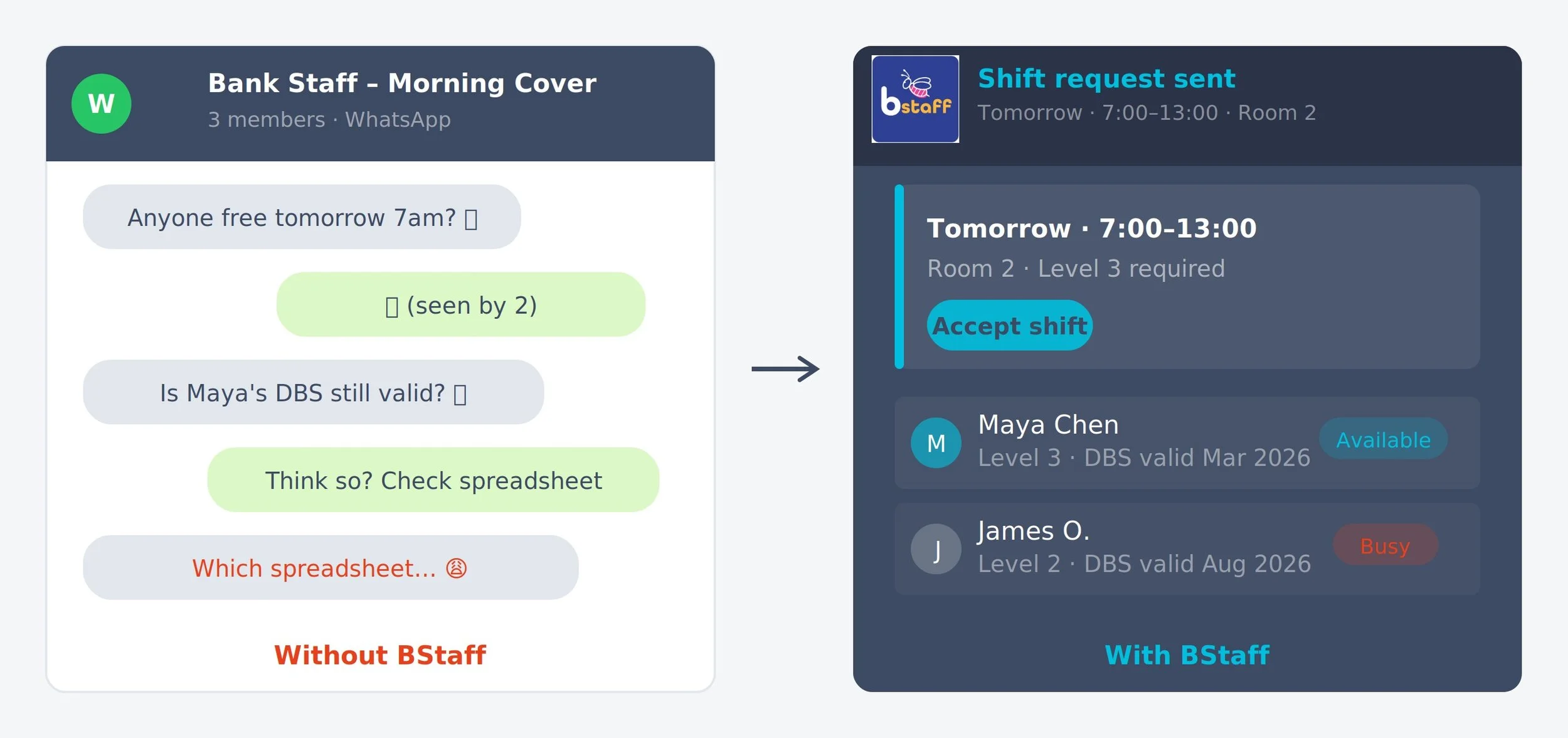
Ask any nursery manager how they manage their bank staff and the answer is almost always the same: a group chat, a spreadsheet, and a lot of chasing. Someone sends a message at 7am. Half the group don't see it. The ones who do respond with a thumbs up that you have to manually cross-reference against their DBS expiry date and the shift they last worked.
What generic tools can't do for early years
Track DBS status, training expiry dates and compliance documents automatically
Confirm ratios are met before a shift is accepted — not after
Give bank staff visibility of their own profile, availability and shift history
Integrate hours directly into payroll without manual re-entry
Flag when a practitioner hasn't worked in 30 days and risks going cold
Surface who is available across multiple sites simultaneously
Generic workforce management platforms have the same problem, just with a better interface. They weren't built for the compliance complexity of early years — the ratio requirements, the qualification tiers, the Ofsted-readiness questions that matter every single day.
Bank staff are cheaper, known to your children, and already compliant with your setting. The only reason they're not your first call is friction.
What a purpose-built system changes

When nurseries and schools simplify how they manage their bank staff, they eliminate a major source of operational stress. The result? Higher engagement, better retention, and a win for everyone involved.
BStaff, Kalendit's bank staff management platform, was built specifically for early years providers. That specificity matters. When a practitioner logs in to the app, they can update their own availability, upload compliance documents, and accept shifts directly — without a manager having to chase, check or manually re-enter anything.
For nursery groups managing multiple sites, it goes further. Shift requests go out to the right pool automatically. Managers see real-time availability, qualifications and compliance status across their whole bank. Hours are confirmed into the system the moment a shift is accepted — not reconstructed from screenshots at the end of the week.
The result is a bank staff pool that actually functions like one. Practitioners stay engaged because the experience is professional. Managers save hours of coordination time per week. And agency becomes a genuine last resort — not a reflex.
The compliance layer you can't ignore
In early years, a staffing tool is only as good as its compliance logic. BStaff is built around the specific requirements of the EYFS — tracking DBS dates, qualification levels, safeguarding certificates and ratio implications as part of the core workflow, not as an afterthought. When you're filling a room at short notice, you need to know immediately whether the person accepting the shift keeps you compliant. BStaff tells you before the shift starts.
Bank staff aren't a backup plan. With the right infrastructure, they're your first line. The question isn't whether your bank staff pool has the capacity to cover more of your rota — it almost certainly does. The question is whether your tools are letting you use it.
Case Study - Kido
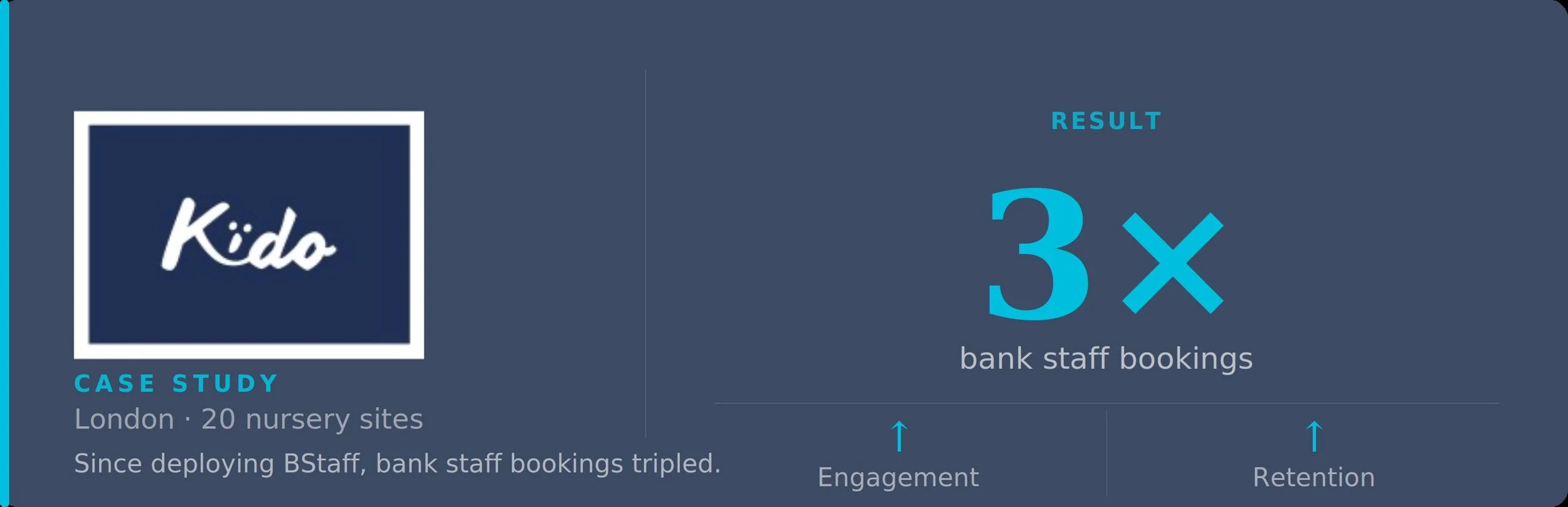
Kido tripled bank staff bookings across 20 London sites
Since deploying BStaff across their network, London-based nursery group Kido has seen bank staff bookings triple — with measurable improvements in bank staff engagement and retention. With 20 sites to coordinate, BStaff gave their team a single system to manage availability, compliance and shift confirmation at scale.
Ready to turn your bank staff into your strongest staffing asset?