

The Hidden Cost of Managing Nursery Staffing by Hand
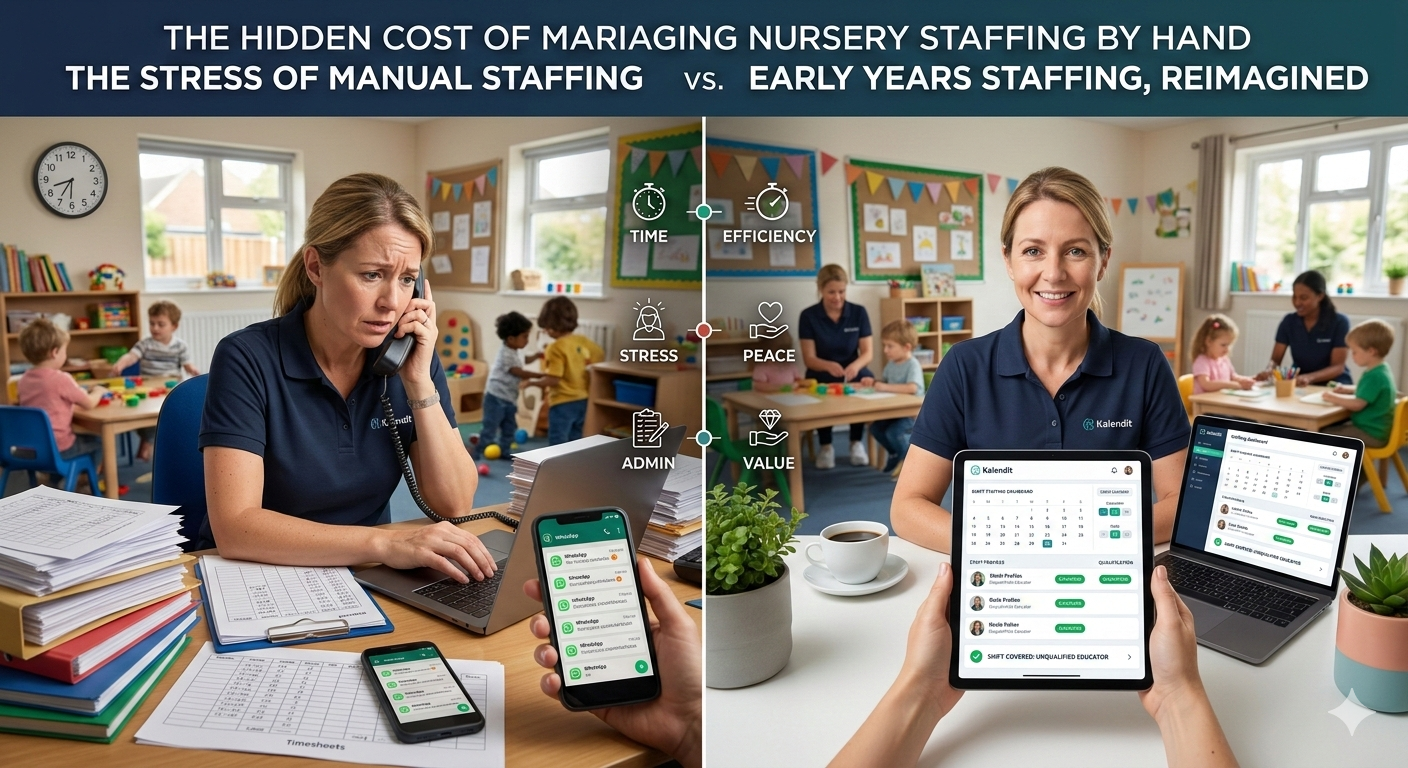
Ask any nursery manager how they fill a staffing gap and you'll hear the same story. A call at 7am. A WhatsApp to the group. A call to the first agency, then a second, then a third. An hour later, maybe it's sorted. Maybe it isn't. This happens multiple times a week, across every site you run — and nobody has ever added up the bill.
Compliance is not a checkbox exercise. It is a legal obligation and an Ofsted requirement. Yet many nurseries are managing their compliance records across a mix of paper files, email threads, and individual managers' memories.
The hours nobody is counting
The cost of manual staffing doesn't show up on a single invoice. It's hidden in the accumulated minutes your managers spend every week on tasks that should take seconds — or not happen at all.
Here is what a typical nursery manager loses each week just to keep the rota running:
Calling and messaging bank staff — 3 to 4 hours per week Checking availability, chasing responses, and confirming shifts one by one via phone or WhatsApp.
Calling agencies when bank staff can't cover — 1 to 2 hours per gap Contacting multiple agencies, waiting for responses, and comparing options under time pressure.
Timesheet management and approvals — 2 hours per week Collecting paper timesheets, chasing sign-offs, and reconciling hours with invoices.
Processing agency invoices — 1 to 2 hours per week Reconciling across multiple agencies, checking hours, and approving payments.
Compliance tracking — 3 to 4 hours per week Monitoring DBS expiry dates, verifying qualification levels before every shift, chasing documents, and maintaining Ofsted-ready records across sites. One of the most time-consuming and most consistently underestimated tasks.
Estimated total: 10 to 14 hours per site, per week.
Across a group of ten sites, that is up to 140 hours of management time every week — the equivalent of more than three full-time roles — spent on administration that generates no educational value whatsoever.
Based on conversations with nursery managers across the UK. Actual figures will vary by group size and staffing model.
The agency cost hiding in your VAT
The margin agencies charge is visible on the invoice. What's less visible is the VAT structure — and it compounds the problem significantly.
With a traditional agency, VAT applies to the entire invoice — the worker's pay rate plus the agency's markup. With Kalendit, you set the rate yourself and VAT applies only to our booking fee — not to the full shift cost. The difference is substantial.
Unqualified educator — 8-hour shift Agency: £17/hr × 8 hours + VAT on full amount = £163.20 Kalendit: £13/hr × 8 hours + VAT on booking fee only = £132.70 Saving: 19% per shift
Qualified educator — 8-hour shift Agency: minimum £25/hr × 8 hours + VAT on full amount = £240.00 Kalendit: £16/hr × 8 hours + VAT on booking fee only = £163.33 Saving: 32% per shift
For a nursery group booking supply staff regularly across multiple sites, the difference adds up to thousands of pounds every month — before you have factored in a single hour of admin time saved.
"The question isn't how much Kalendit costs. It's what your current approach is already costing you — in money, in manager time, and in the stress of a 7am gap on a Monday morning."
The invisible cost of hiring the wrong person
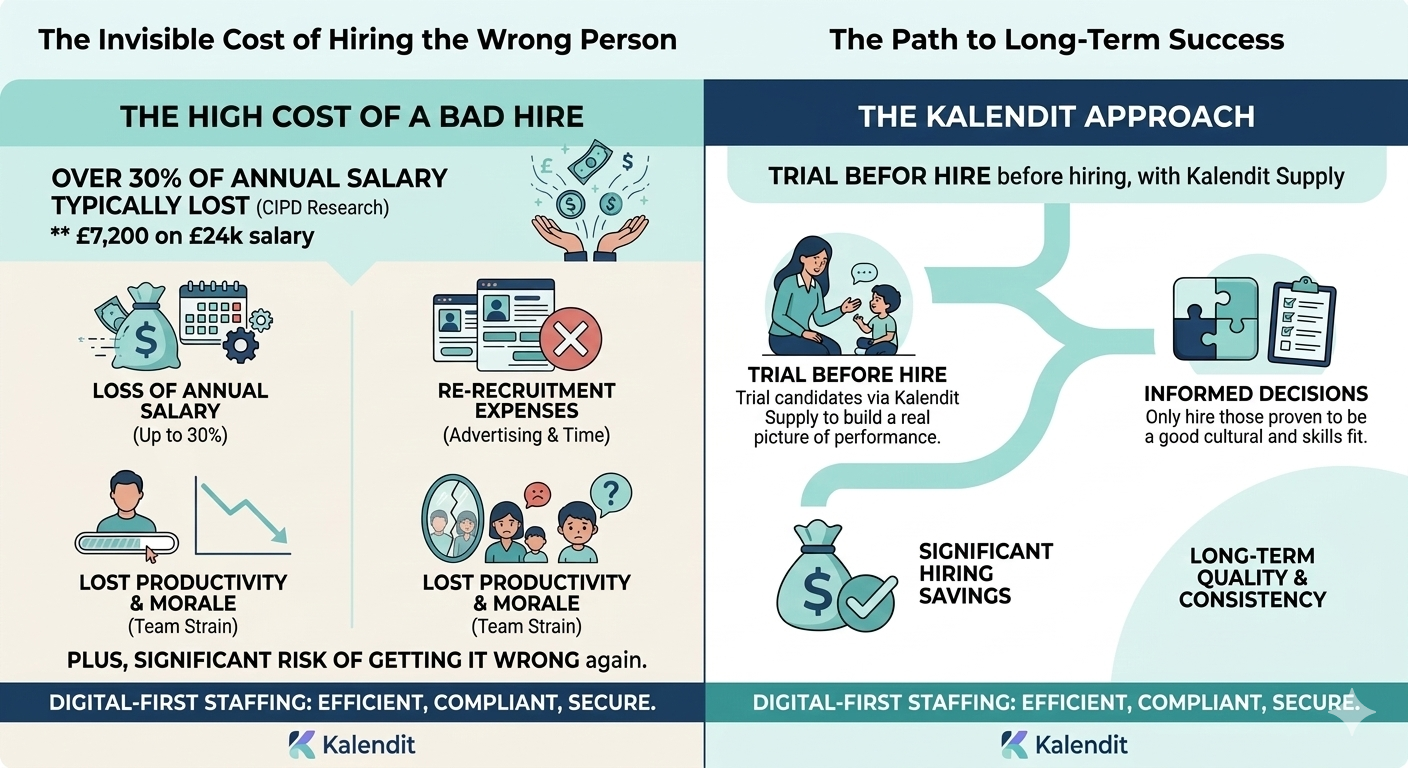
According to CIPD research, the cost of a bad hire is typically around 30% of annual salary. On a £24,000 salary, that is £7,200: notice periods, re-recruitment, lost productivity, and the disruption to your team and the children in their care.
Beyond the weekly staffing grind, there is a bigger financial risk that nursery groups consistently underestimate: permanent recruitment.
Most nurseries hire one of two ways. They either post on a job board and interview candidates themselves, or they use a recruitment agency. Both carry a cost that is easy to overlook — and both pale against the cost of getting it wrong.
Route 1: DIY — job board and manager time A job board listing costs around £250. Shortlisting CVs, conducting three interviews, and handling admin takes a manager roughly 8 hours — around £120 in staff time at a blended rate. Total upfront cost: approximately £370.
That looks cheap. But it buys you a one-hour interview and a reference check. If the hire does not work out — and in early years, a poor cultural or quality fit is identified quickly and expensively — the cost of unwinding it is significant. According to CIPD research, the cost of a bad hire is typically around 30% of annual salary. On a £24,000 salary, that is £7,200: notice periods, re-recruitment, lost productivity, and the disruption to your team and the children in their care.
Route 2: Recruitment agency An agency charges 15 to 20% of gross annual salary. On a £24,000 role, that is £3,600 to £4,800 — before you have seen the candidate work a single shift.
The Kalendit approach Nursery groups that use Kalendit Supply trial an educator on a supply basis first — booking them for shifts across their sites and building a real picture of how they work with children, respond to the team, and handle the unexpected. By the time they make a permanent offer, the decision is informed rather than hopeful.
When you are ready to make that move:
Permanent contract introduction fee: 10% of gross annual salary — £2,400 on a £24,000 role
Bank staff contract fee: £1,200 +VAT (unqualified) or £2,400 +VAT (qualified)
Saving vs recruitment agency: £1,200 to £2,400 per hire — a 33 to 50% reduction.
And unlike an agency placement, you already know this person works well in your setting. The risk of a bad hire — and its £7,200 price tag — is substantially reduced.
What a digital-first approach looks like in practice
Kalendit's two products — BStaff and Kalendit Supply — are built specifically for early years settings. Not adapted from a generic workforce tool. Built from scratch for nurseries, by people who understand how they operate.
BStaff — bank staff management built for early years
BStaff replaces WhatsApp groups and spreadsheets with a dedicated platform for your internal bank staff pool.
Post shifts in seconds — bank staff accept directly from the app
Bank staff update their own availability — no more chasing
Single Central Record for all bank staff across every site
Qualification and DBS visibility at the point of every booking
Digitalised timesheets with dual confirmation — no paper, no disputes
Ratings after every shift — build quality and accountability
Group-level reporting and visibility across all sites
Bespoke configuration — built around your existing workflows
Kalendit Supply — on-demand qualified supply staff when your bank can't cover
Book supply staff via web portal or app — 24 hours a day, 7 days a week
You set the hourly rate — no agency markup imposed
VAT on booking fee only — not on the full shift cost
Automated DBS, qualification and right to work checks
Ratings system — favourite and recall educators you trust
One consolidated invoice — not one per agency per week
Temp-to-perm pathway — trial before you hire
Seamless escalation from BStaff when bank staff cannot fill a gap
Crucially, both products sit in the same platform. For nursery groups managing bank staff and supply staff side by side, that means one place for all shift activity, all timesheets, all compliance records, and all reporting — rather than a patchwork of apps, spreadsheets, and agency portals.
What happened when Kido went all-in

Kido was Kalendit’s first client when it launched in 2018. Today, it is using Kalendit exclusively for supply staff and bank staff management with Bstaff.
Kido is one of the UK's fastest-growing nursery groups. Three years ago, they adopted BStaff across their 20 sites and made Kalendit their sole staffing partner. Today, they use the platform every single day.
Since adopting BStaff, Kido has tripled its bank staff bookings and seen a significant improvement in bank staff engagement and retention compared to their previous system.
What drove that improvement? Bank staff who can update their own availability, receive shift notifications instantly, and get rated and recognised after every shift are more engaged — and more likely to keep accepting work. BStaff transforms the bank staff relationship from a passive list of phone numbers into an active, two-way system that works for everyone.
Quality, compliance, and safety — built in, not bolted on
For nurseries, compliance is not a checkbox exercise. It is a legal obligation and an Ofsted requirement. Yet most nursery groups are managing their compliance records across a mix of paper files, email threads, and individual managers' memories.
Single Central Record Every bank staff member and supply educator has a live, Ofsted-ready record — qualifications, DBS status, right to work — accessible across all your sites at any time.
Automated expiry tracking DBS certificates, qualifications, and right to work documents are tracked automatically. Educators are suspended from booking if a document expires — no manual monitoring required.
Ratings and performance history Every shift generates a rating. Over time, you build a quality picture of every educator — who your managers trust, who to recall, and who to move on from.
Digitalised timesheets Hours are confirmed by both the educator and the nursery manager at the end of every shift. No paper. No disputes. A clean audit trail for every booking across every site.
The result is a staffing operation that is not only more efficient — it is more consistent, more compliant, and safer for the children in your care.
Ready to see what Kalendit can do for your nursery group?
Think you know what your staffing is costing you? Book a 30-minute call and we'll show you the number you're not seeing
Kalendit Ltd · Early years staffing, reimagined · kalendit.com